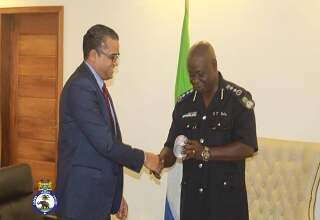
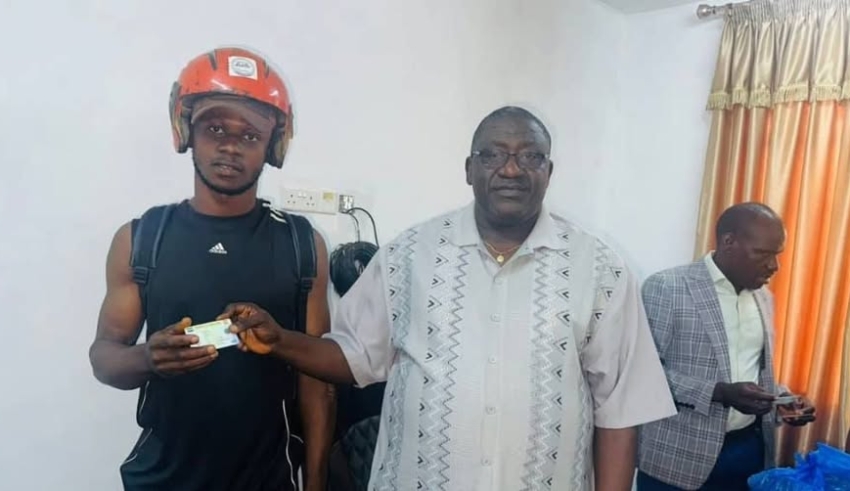
In a demonstration of government commitment to inclusive service delivery and youth empowerment, the National Civil Registration Authority (NCRA), in collaboration with the Institute for Democratic and Humanitarian Affairs (IDHA), and the Bike Riders Union (BRU) have successfully concluded the first phase of a nationwide initiative to provide National Identification Cards to commercial motorbike riders across Sierra Leone — with all 3,000 cards now formally handed over to the executive of the Bike Riders Union for distribution to beneficiaries.
The initiative targeted commercial youth motorbike riders across five districts — Western Urban, Western Rural, Bo, Kenema, and Bombali (Makeni) — with 600 riders per district enrolled during the first phase.
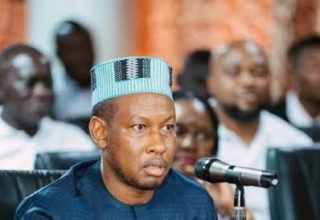
NCRA Director General Mr. Mohamed Mubashir MASSAQUOI described the initiative as a living expression of President Julius Maada Bio’s declaration of 2026 as the “Year of Action,” reaffirming the government’s determination to bring essential services directly to the people rather than requiring citizens to navigate bureaucratic processes from a distance. He emphasised that the handover of all 3,000 cards is concrete proof that the government is delivering on its commitments.
To operationalise that vision, mobile NCRA teams were deployed to designated centres jointly identified with the Bike Riders Union over a two-week period. During this time, beneficiaries applied for new national ID cards, collected their printed cards, and updated personal records including names and other biographic details. The successful completion of that process and the formal handover of all 3,000 cards to the union’s executive marks the close of the first phase.
Mr. MASSAQUOI further stressed that possession of a national ID card is no longer optional. It is increasingly required for access to financial services, motorcycle registration, licensing, social protection, and law enforcement processes — making the initiative not merely a civic gesture, but a practical intervention in the daily lives of thousands of young Sierra Leoneans. He added that a reliable national identification system strengthens law enforcement, emergency response, and social protection frameworks, particularly in situations involving accidents or civil disputes.
The project is anchored by research. IDHA Programme Director Mr. Olagai Simon explained that the intervention was designed in direct response to findings from financial behavioural studies conducted among bike riders across the five districts, which revealed that the absence of national identification was a primary barrier excluding many young riders from banking, credit, and other financial services.
Mr. Simon also disclosed that the ID card initiative forms part of a broader programme titled “Empowering Youth Bike Riders as Agents of Peace in Sierra Leone,” which encompasses financial literacy training, alternative livelihood skills, technical and vocational education, and access to bike loans. To date, over 1,200 riders are enrolled in skills training programmes, while thousands more have benefited from business and financial management training