𝐁𝐲 𝐀𝐛𝐝𝐮𝐥 𝐌𝐚𝐥𝐢𝐤 𝐁𝐚𝐧𝐠𝐮𝐫𝐚 𝐄𝐒𝐐
The decision of the Economic Community of West African States (ECOWAS) Authority of Heads of State and Government to elect a new Chairperson in 2026 instead of retaining Sierra Leone’s President Julius Maada Bio for another term has generated considerable public debate. Some have interpreted the outcome as a vote of no confidence in Sierra Leone’s leadership. However, such an interpretation overlooks both the history of ECOWAS leadership transitions and the exceptional geopolitical circumstances that have previously justified extending the tenure of certain chairpersons.
It is worth noting that the ECOWAS Protocol and established practice provide for rotational leadership among member states. While there is no constitutional prohibition against a Chairperson serving beyond one year, extensions have historically occurred only under extraordinary circumstances requiring continuity of leadership.
President Bio’s tenure from 2025 to 2026 was conducted during an important period for regional diplomacy, democratic governance and economic integration. However, unlike previous exceptional cases, the regional environment did not present a singular crisis requiring the same Chairperson to remain in office.
John Mahama and the Ebola Crisis
One of the most cited precedents is Ghanaian President John Dramani Mahama. Mahama’s chairmanship was extended because West Africa was battling the deadliest Ebola epidemic between 2014 and 2016. The epidemic primarily had its epicenter in 3 ECOWAS nations such as Guinea, Liberia and Sierra Leone and later Nigeria, causing more than 28,000 reported infections and over 11,000 deaths, making it the deadliest Ebola outbreak ever recorded.
The epidemic devastated economies, closed borders, disrupted trade, overwhelmed fragile health systems and required unprecedented regional coordination involving ECOWAS, the African Union, the United Nations and international partners. Changing leadership during such an unprecedented humanitarian emergency would have risked disrupting coordinated regional action.
ECOWAS became one of the principal regional institutions coordinating cross-border surveillance; humanitarian assistance; deployment of health personnel; diplomatic engagement with international partners and regional economic recovery planning.
Changing leadership in the middle of such an unprecedented public health emergency could have disrupted regional coordination. Continuity therefore became a strategic necessity rather than a political reward. Mahama’s retention reflected the extraordinary demands of the Ebola response—not a permanent departure from ECOWAS’s rotational principle.
Nana Akufo-Addo’s Second Term Was Justified by COVID-19
Similarly, former Ghanaian President Nana Akufo-Addo remained ECOWAS Chairman (2020–2022) beyond the normal tenure because of the COVID-19 pandemic. COVID-19 represented an entirely different but equally extraordinary challenge.
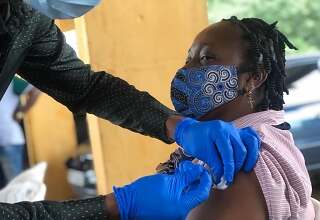
By the end of Akufo-Addo’s tenure Millions of COVID-19 infections had been recorded across Africa. ECOWAS countries faced repeated border closures as international travel collapsed, supply chains were severely disrupted, vaccination programmes required coordinated regional responses and economic recovery depended upon harmonized public health measures.
West African governments had to coordinate vaccine procurement, border reopening strategies, health surveillance and economic recovery programmes simultaneously.
Maintaining the same ECOWAS Chairperson ensured policy consistency throughout one of the greatest public health crises in modern history.
Again, the extension was based on necessity not political favour.
President Bola Ahmed Tinubu’s Extension Was Closely Linked to the Niger Crisis
President Bola Ahmed Tinubu’s continuation also arose from extraordinary regional security circumstances. Only weeks after assuming the ECOWAS Chairmanship, Niger experienced the July 2023 military coup that removed President Mohamed Bazoum.
The crisis immediately became one of the most serious constitutional challenges ECOWAS had faced in decades
As Chairperson, Tinubu led emergency ECOWAS summits; diplomatic negotiations; sanctions against the military authorities; engagement with the African Union and the United Nations and discussions regarding the possible deployment of the ECOWAS Standby Force.
Geographically, Nigeria naturally assumed the leading role because it shares a border of over 1,500 kilometres with Niger; is ECOWAS’s largest economy; contributes significantly to ECOWAS peacekeeping capacity and supplies electricity and major trade links to Niger.
Replacing the Chairperson during such sensitive negotiations could have complicated ongoing diplomatic efforts. Continuity therefore became a practical necessity.
President Bio Did Not Face a Comparable Exceptional Circumstance
By contrast, Sierra Leone’s chairmanship from 2025 to 2026 was not defined by an equivalent regional emergency requiring continuity. Of course President Bio inherited several regional challenges, including democratic governance issues, terrorism concerns in the Sahel and economic pressures. However, these were ongoing structural issues rather than sudden crises requiring exceptional continuity of leadership under the ECOWAS Authority. Indeed, one of the hallmarks of a mature regional organisation is respecting institutional rotation when extraordinary circumstances no longer justify an exception.
Accordingly, the transition from President Bio to a new Chairperson should be viewed as a return to the normal rotational principle rather than a rejection of Sierra Leone’s leadership.
Why Senegal Is Strategically Positioned Now
The choice of Senegal can also be viewed through the lens of regional diplomacy. ECOWAS’s immediate challenge is no longer solely managing coups. It is rebuilding trust with the Alliance of Sahel States (AES), comprising Mali, Burkina Faso and Niger, while maintaining constructive engagement with Mauritania.
Senegal possesses several strategic advantages. First, Mali relies heavily on Senegal’s Port of Dakar for international trade, making Senegal one of Mali’s most important economic partners. This provides Dakar with practical channels of influence beyond formal diplomacy.
Second, Senegal enjoys deep cultural, religious and linguistic ties with several Sahelian countries. Shared Francophone heritage, longstanding commercial networks and influential Islamic brotherhoods create avenues for dialogue that are difficult to replicate elsewhere.
Third, Senegal has traditionally maintained cordial diplomatic relations across both coastal West Africa and the Sahel, positioning it as a credible bridge-builder at a time when ECOWAS seeks reconciliation rather than confrontation.
If ECOWAS’s strategic objective is to encourage the eventual reintegration of Mali, Burkina Faso and Niger into the regional bloc while strengthening engagement with neighbouring Sahel states, Senegal is well placed to lead those efforts.
ECOWAS Chairmanship: Strategy Over Achievement
A critical point often overlooked in discussions about the ECOWAS Chairmanship is that the Authority has historically based its leadership decisions more on the strategic needs of the region at a particular moment than on an assessment of the outgoing Chair’s achievements or performance.
The office is not an award for the most successful President, nor is re-election a recognition of exceptional accomplishments. Rather, ECOWAS has demonstrated a pragmatic approach by retaining leaders only when continuity was considered essential to managing extraordinary regional crises. President John Mahama’s tenure was extended to ensure uninterrupted coordination during the devastating Ebola epidemic. President Nana Akufo-Addo remained in office to steer the region through the unprecedented COVID-19 pandemic. President Bola Ahmed Tinubu’s tenure was prolonged because Nigeria was at the forefront of ECOWAS’s response to the constitutional crisis following the military coup in Niger.
Conversely, when no comparable circumstance exists requiring continuity, ECOWAS has consistently reverted to its tradition of rotating the chairmanship among Member States. Thus, the transition from Sierra Leone to Senegal should be understood not as a verdict on Sierra Leone’s performance, but as a strategic decision reflecting the bloc’s current priority of re-engaging the Sahel states—particularly Mali, Burkina Faso and Niger where Senegal’s geographical position, economic ties, cultural affinity and Francophone influence may offer unique diplomatic advantages in advancing ECOWAS’s objective of regional reunification.